Why is intelligent lighting becoming a competitive advantage?
In an era where smart buildings and the internet of things are no longer vision but reality, intelligent lighting control has become a decisive factor. Whether in production halls, commercial properties, or street lighting, DALI (Digital Addressable Lighting Interface) has established itself as the global standard.
The business case is compelling: demand-driven control, daylight harvesting, and preventive maintenance through integrated diagnostics reduce operating costs. The flexible adaptation to changing usage scenarios creates additional value.
What is DALI and how does it work?
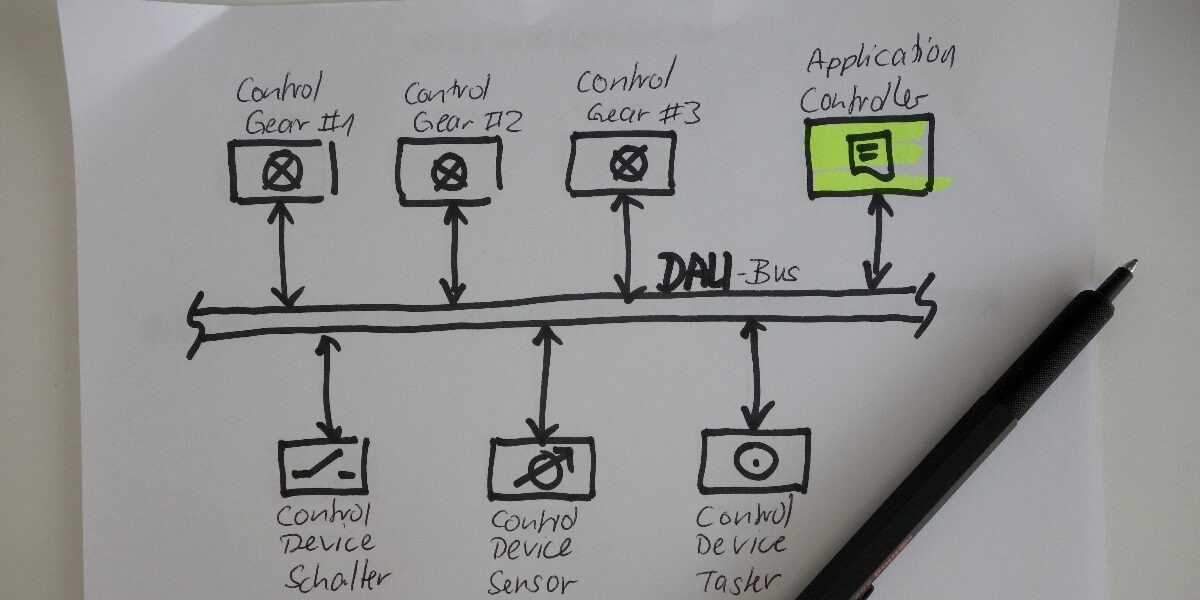
DALI is based on a digital bus system that makes lighting flexible and precisely controllable. The principle is elegant and well thought out:
Control gears, also known as LED drivers, have two separate connections – one for electrical power and one for the DALI bus for control purposes. Via this bus, luminaries can be specifically switched on and off, dimmed, adjusted in light color, and monitored. Maintenance data, consumption values, and even emergency lighting systems can be captured and controlled.
Control devices are the counterpart: switches, push buttons, presence detectors, or brightness sensors. Particularly relevant for intelligent buildings are sensors that automatically detect where people are present and adjust the lighting autonomously and energy-efficiently. Modern DALI systems enable, for example, human centric lighting: the lighting adapts not only in brightness but also in color temperature to the time of day. In the morning and during the day, cooler, bluish-white light promotes concentration and alertness, while warm white light in the evening contributes to relaxation. This demonstrably increases well-being and productivity.
The application controller processes the sensor data and generates the corresponding commands for the control gears. The DALI standard precisely defines the format in which data is exchanged.
The DALI standard is published in the International Electrotechnical Commission (IEC 62386) standards and is publicly accessible to everyone. The DALI Alliance, a consortium of leading manufacturers, continuously develops the standard further.
Why is DALI the market standard?
DALI has prevailed because it offers practical solutions for all stakeholders:
For manufacturers and product development
The technical concepts are clearly defined and can be implemented with any current microcontroller. Certification as a DALI-2 device is transparent and calculable: with access to a DALI test device, the standardized test sequences can be run independently. The automatically generated protocols are submitted – done.
Critical for development planning: certification can occur in parallel with development. This minimizes risks and significantly accelerates time-to-market.
This low entry barrier has led to an impressive variety of devices. The DALI-2 logo guarantees interoperability – devices from different manufacturers work together seamlessly. For product managers, this means: the customer base is hardly limited by broad integration possibilities.
For installation
The galvanic isolation between the DALI bus and mains supply allows joint routing in one cable – typically, two cores of a NYM 5 × 1.5 mm² cable are simply used as the bus line. Switches, push buttons, and sensors often require only minimal power and can be supplied directly from the DALI bus. Thus, they only need two wires.
The topology of the DALI bus can be freely chosen and polarity doesn’t matter. This makes wiring on the construction site particularly forgiving of errors – a real cost advantage.
What technical challenges and development perspectives exist?
Application controllers – the central intelligence
The standard makes precise specifications for control gears and control devices. However, when linking these components – the task of the application controller – the requirements of IEC 62386 become less concrete.
The challenge: this openness enables innovative solutions but also leads to proprietary approaches and complex configuration procedures. Tools like dali-cli offer full functionality but require deep DALI knowledge.
The opportunity: there is enormous potential here for differentiation and genuine innovation. Those who develop clever, standard-compliant solutions create real added value.
The path to a wireless future
Radio standards such as Bluetooth Low Energy, Zigbee, or Thread are technically mature and facilitate integration into existing buildings without rewiring. The DALI Alliance has already responded with DALI+ (IEC 62386 Part 104).
Particularly exciting for developers: the integration of DALI with modern wireless protocols, IoT platforms, and cloud services. This is where the next generation of smart building solutions is emerging.
How do you develop a DALI device from idea to certification?
Developing a DALI device follows clear specifications but also brings unusual requirements:
Hardware design
An example: the edges of DALI signals must not be too steep. This is an unusual requirement in digital signal processing, but it prevents the bus, distributed over many meters, from radiating too much electromagnetic power and violating EMC specifications. Such details make DALI development both demanding and interesting.
Software architecture
In software development, it’s essential to consider all standard requirements and consciously decide where additional functions make sense without conflicting with the standard.
The advantage in the development process: certification using a DALI tester can occur in parallel with development. The test sequences provided by the DALI Alliance significantly reduce the effort for in-house testing and ensure product quality.
How does sevenlab support your DALI projects?
Our experience covers the entire development cycle:
From product idea to series production: We translate customer requirements into technical specifications and support through to series production readiness. Hardware design, component selection, PCB layout, CE and DALI certification, as well as EMC conformity – we have successfully mastered these challenges repeatedly.
Software development: We develop firmware for control gears and control devices based on extensive experience from many projects that have met diverse requirements. Additionally, we implement configuration software and interfaces to other smart building solutions.
Integration: Connection to cloud platforms, IoT systems, and building management software.
Why use a ready-made DALI stack?
From numerous DALI projects, we have identified recurring elements and bundled them into a library: the sevenlab-dali-stack.
What the stack delivers
The protocol stack implements all standard-compliant properties and behaviors of a DALI product – regardless of whether it acts as a control gear or control device, including various device types.
Technical characteristics:
-
Programmed in C, easily portable to different microcontrollers
-
Clear interfaces and clean architecture
-
Efficient use of processor resources
-
Standard-compliant and certifiable
Your advantages
For development: Developers can focus on the application instead of protocol details. This significantly accelerates development and reduces the risk of costly implementation errors.
For project management: Products are created in the shortest possible time on a standardized basis. This means predictable coding efforts and reduced development risks.
For maintenance: Care and updates can be organized efficiently across products. This reduces long-term maintenance effort.
For business: Faster time-to-market with simultaneously higher product quality. That’s the decisive competitive advantage.
What’s next for your DALI project?
Whether you want to refine your product idea, expand an existing system, or develop a completely new DALI device – we develop the right solution for your requirements.
Typical project scenarios:
-
Integration of DALI into existing product lines
-
Development of customer-specific DALI devices
-
Links to other protocols
-
Wireless DALI solutions (DALI+, BLE, Thread)
Get in touch and share your idea with us. Together we will develop a tailored approach that makes your DALI project successful.
We look forward to hearing from you!